What a perc test costs in 2026
A percolation test, or “perc test,” is the soil evaluation your county uses to decide whether your land can support a conventional septic drain field. In 2026 the national average runs about $750 to $1,900, and most homeowners pay somewhere near $1,000–$1,300. The full range is wider than that average suggests: a single hand-dug hole on a small rural lot can cost as little as $250–$300, while machine-dug holes on a large parcel, or a test bundled with a soil scientist and an engineered-system design, can push past $3,500.
The reason the range is so wide is that “perc test” can mean two very different jobs. On easy, sandy ground a technician may need one shallow hole and an afternoon. On difficult clay ground in a strict county, the same permit can require multiple deep holes, a licensed soil scientist, and a drawn engineering report: four line items instead of one. That is why we built a calculator that asks for the inputs that actually move the number, instead of guessing from a ZIP code alone.
Perc test cost by state
Costs cluster by region. The Northeast and Midwest tend to run higher: clay-heavy soils, stricter rules, and winters that freeze the ground all push toward engineered systems and added design work. The South and Southwest are usually cheaper, where sandy soils favor conventional systems. The West is the most variable. Mountainous or rocky terrain often forces a mound or engineered system that raises the total.
Texas, California and Florida below are drawn from published 2026 quotes. The remaining states use a regional baseline (see how each row is derived); treat them as a starting range and confirm with a local provider.
| State | Typical perc test | Region | Source |
|---|---|---|---|
| Alabama | $300–$1,200 | SE | regional est. |
| Alaska | $400–$3,500 | West | regional est. |
| Arizona | $250–$900 | SW | regional est. |
| Arkansas | $300–$1,200 | SE | regional est. |
| California | $250–$3,500 | West | researched |
| Colorado | $400–$3,500 | West | regional est. |
| Connecticut | $800–$3,000 | NE | regional est. |
| Delaware | $800–$3,000 | NE | regional est. |
| Florida | $750–$1,900 | SE | researched |
| Georgia | $250–$500 | SE | researched |
| Hawaii | $400–$3,500 | West | regional est. |
| Idaho | $400–$3,500 | West | regional est. |
| Illinois | $700–$2,500 | MW | regional est. |
| Indiana | $700–$2,500 | MW | regional est. |
| Iowa | $700–$2,500 | MW | regional est. |
| Kansas | $700–$2,500 | MW | regional est. |
| Kentucky | $300–$1,200 | SE | regional est. |
| Louisiana | $300–$1,200 | SE | regional est. |
| Maine | $800–$3,000 | NE | regional est. |
| Maryland | $800–$3,000 | NE | regional est. |
| Massachusetts | $800–$3,000 | NE | regional est. |
| Michigan | $700–$2,500 | MW | regional est. |
| Minnesota | $700–$2,500 | MW | regional est. |
| Mississippi | $300–$1,200 | SE | regional est. |
| Missouri | $700–$2,500 | MW | regional est. |
| Montana | $400–$3,500 | West | regional est. |
| Nebraska | $700–$2,500 | MW | regional est. |
| Nevada | $400–$3,500 | West | regional est. |
| New Hampshire | $800–$3,000 | NE | regional est. |
| New Jersey | $800–$3,000 | NE | regional est. |
| New Mexico | $250–$900 | SW | regional est. |
| New York | $800–$3,000 | NE | regional est. |
| North Carolina | $500–$1,500 | SE | researched |
| North Dakota | $700–$2,500 | MW | regional est. |
| Ohio | $700–$2,500 | MW | regional est. |
| Oklahoma | $250–$900 | SW | regional est. |
| Oregon | $400–$3,500 | West | regional est. |
| Pennsylvania | $650–$2,400 | NE | researched |
| Rhode Island | $800–$3,000 | NE | regional est. |
| South Carolina | $300–$1,200 | SE | regional est. |
| South Dakota | $700–$2,500 | MW | regional est. |
| Tennessee | $300–$1,200 | SE | regional est. |
| Texas | $250–$600 | SW | researched |
| Utah | $400–$3,500 | West | regional est. |
| Vermont | $800–$3,000 | NE | regional est. |
| Virginia | $500–$1,500 | SE | researched |
| Washington | $400–$3,500 | West | regional est. |
| West Virginia | $300–$1,200 | SE | regional est. |
| Wisconsin | $700–$2,500 | MW | regional est. |
| Wyoming | $400–$3,500 | West | regional est. |
Sources: HomeGuide, Angi, Texas Septic Guide, CostHelper (2026). Ranges are for the test only, not the full system.
The 5 factors that change your perc test cost
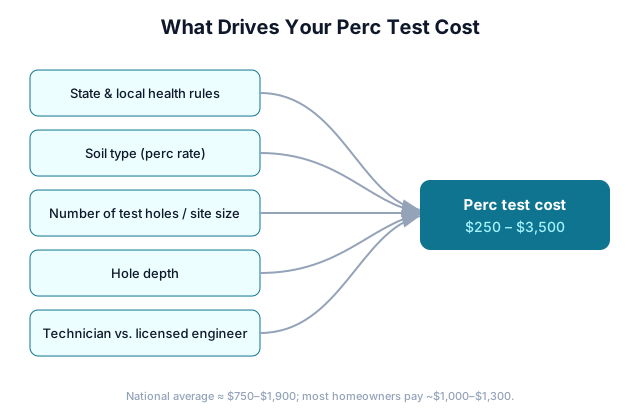
- State & local health rules. Your county health department sets how many holes, how deep, and who is allowed to sign off. Two identical lots in different counties can carry very different permit and testing requirements.
- Soil type (perc rate). Sandy soil drains quickly and usually passes with a small drain field. Clay drains slowly and may fail a conventional test, forcing a costlier engineered or mound system.
- Number of test holes. This is the biggest single swing. Small lots may need one or two hand-dug holes ($200–$1,500 total); larger parcels can require several machine-dug holes ($500–$3,000+).
- Hole depth. Deeper holes cost more, roughly $100–$150 per extra foot per hole, and deep testing is common where the water table or bedrock is a concern.
- Who performs the test. A basic technician is cheapest. A licensed soil scientist or engineer, or a bundled engineering report, adds hundreds of dollars. One Pennsylvania homeowner’s $2,400 quote broke down as a $650 test, $500 soil scientist, $750 excavator, and $1,400 system design.
How soil type drives the whole system
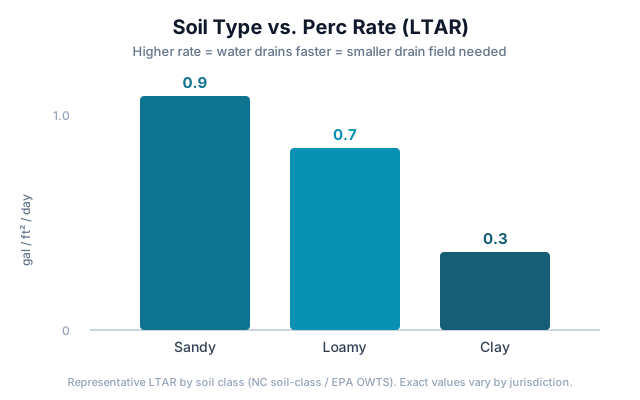
The perc test produces a drainage rate engineers call the Long-Term Acceptance Rate (LTAR), measured in gallons per square foot per day. Sandy soils sit around 0.9, loam around 0.7, and clay near 0.3. A lower LTAR is not just a “fail” risk. It directly enlarges the drain field, because slower soil needs more area to absorb the same volume of effluent. That is how a soil result quietly becomes a five-figure difference in total system cost. Already have a report? See how to read your perc test results.
From perc result to drain field size and total cost
Most states size the system from design flow, commonly 150 gallons per day per bedroom (some states use 120). The required drain field area is simply design flow divided by the LTAR. A three-bedroom home is 450 gallons per day; on loam (0.7) that is roughly 640 square feet of field, but on clay (0.3) it balloons to about 1,500 square feet — more excavation, more pipe, more cost.
Layer the field onto the rest of the system and you can see why the perc test is the cheap part of an expensive decision. A conventional septic system typically runs $5,000–$12,000 for the drain field, $700–$2,000 for the tank, and $1,500–$6,300 for excavation. An average install runs around $8,000, and $7,000–$20,000 for engineered systems. The calculator above rolls these together so the test number is shown in context, not in isolation.
How to keep your perc test cost down
- Call the county first. Ask exactly how many holes and what depth are required before you book. It saves you from paying for testing you don’t need.
- Bundle wisely. If you’ll need an engineered design anyway, a combined test-plus-design quote is often cheaper than buying them separately.
- Test in season. Frozen or saturated ground can stop testing (and in the northern states it’s prohibited), so scheduling around the weather avoids repeat trips.
- Hand-dug for small lots. Where the county allows it, one or two shallow hand-dug holes is far cheaper than mobilizing an excavator.
- Test before you buy raw land. A failed perc can mean an engineered system worth tens of thousands. Cheaper to learn that during due diligence than after closing.
What if the ground won’t perc?
A poor result isn’t the end of the road, but it changes the budget. Options include an engineered or mound system, an aerobic treatment unit, or in some counties a holding tank. Each adds cost and often ongoing maintenance, which is exactly why the perc test, at a few hundred dollars, is worth doing carefully before you commit to a lot. Already got a bad result? See Failed a perc test? Here’s what to do.
How long does a perc test take, and how long is it valid?
The fieldwork itself is usually a half-day to a full day, but the real timeline is longer. Many counties require the holes to be pre-soaked (saturated for hours, sometimes overnight) so the reading reflects worst-case conditions rather than dry summer soil. Add scheduling with the health department, the technician’s travel, and the written report, and a “one-day” test can realistically span one to three weeks from booking to permit-ready paperwork.
Results also expire. Depending on the jurisdiction, a passing perc is typically valid for two to five years; after that, or if the site is disturbed by grading, a retest may be required. Season matters too. A lot that percs in dry August can fail in a wet spring, which is why some counties insist on testing during the high-water-table season. If you’re buying raw land, confirm both the validity window and the required test season before you rely on an old report.
Perc test vs. soil evaluation vs. site evaluation
The terms get used interchangeably, but they aren’t the same job, and the difference shows up on the invoice. A classic percolation test times how fast water drops in a saturated hole. Many states have moved to a soil (profile) evaluation, in which a licensed soil scientist reads texture, structure, and the depth to a limiting layer such as bedrock or a seasonal water table, often instead of, or alongside, the timed test. A site evaluation is the broadest assessment: soils plus slope, setbacks from wells and property lines, and available area.
Why it matters for budgeting: a timed perc test can be run by a technician for a few hundred dollars, while a soil-scientist evaluation and a full site evaluation carry professional fees that can double or triple the bill. Ask your county which one your permit actually requires. Paying soil-scientist rates for a job that only needs a technician is one of the most common ways homeowners overspend here.
FAQ
How much does a perc test cost?
Nationally a perc test averages about $750–$1,900, with most homeowners paying $1,000–$1,300. It can be as low as $250–$600 in states like Texas and as high as $3,500+ in parts of California and the Northeast, depending on test holes, soil, and county rules.
What is a perc test?
A percolation (“perc”) test measures how fast water drains through your soil. That rate decides whether a conventional septic drain field will work on your lot, and how big it has to be.
Does soil type change the cost?
Yes. Slow-draining soils such as clay often need a larger drain field or an engineered/mound system, which raises the full system cost even when the test itself costs about the same.
How many test holes will I need?
It depends on your county and lot size. Small lots may need one or two hand-dug holes; larger parcels can require several machine-dug holes, which is the single biggest swing in the price.
Can I do a perc test in winter?
Often no. In Minnesota, Wisconsin, Michigan and much of the Northeast, agencies prohibit perc testing when the ground is frozen or snow-covered, so you may have to wait for a thaw.
Sources
- U.S. EPA: Onsite Wastewater Treatment Systems (design guidance)
- State health codes, e.g. NC 15A NCAC 02T, CT DPH design sewage flow, MD COMAR 26.04.02.05
- HomeGuide, Angi, CostHelper: 2026 perc test cost data
- Texas Septic Guide: Texas perc test pricing
⚠️ Estimates are planning figures, not a quote. Non-researched states use a regional baseline, so confirm with your county and a local provider.